Free delivery on two shirts or more | 30-day returns | 12-month warranty
English
Support



Free delivery on two shirts or more | 30-day returns | 12-month warranty
OUR BLOG
Latest news, tips, and insights
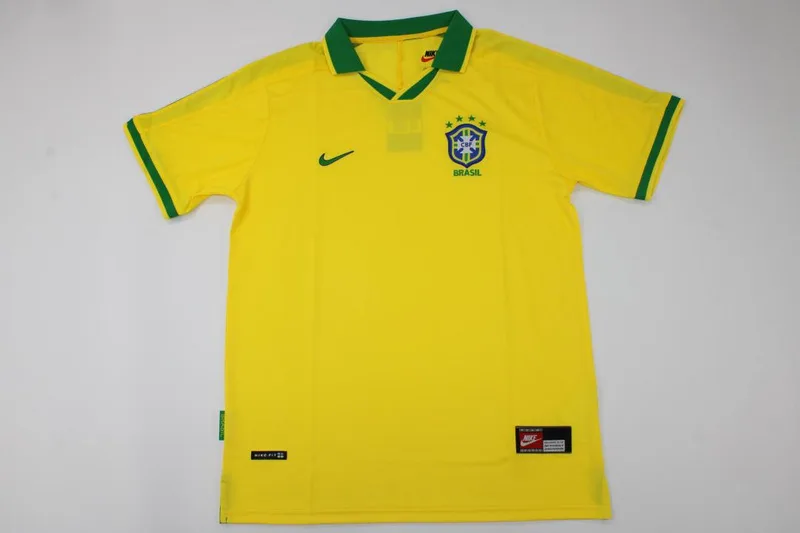
Choose a World Cup shirt for its silhouette, colour story and tournament memory, not just the name on the back.
World Cup football shirts are small pieces of visual history. A collar shape, a sleeve trim or a graphic panel can instantly place you in a summer, a stadium and a match you have watched a hundred times since. The most memorable designs are not always the loudest. Some endure because they are almost minimal; others because they captured a national mood with colour, pattern and a fearless sense of the moment.
A great World Cup shirt needs three things: a clear national identity, a design detail that is easy to recognise, and a tournament story strong enough to keep the image alive. That is why a plain yellow Brazil shirt can be as powerful as a heavily patterned 1990s design. One works through colour and silhouette; the other through graphics and attitude.
Collectors often start with the country or player, but the smarter way to compare shirts is visual. Look at the neckline, sleeve cuffs, badge placement, fabric texture, number style and how the shirt sits on the body. In our national team football shirts collection, those details help separate a timeless design from a shirt that simply belongs to a famous match.
The early television age produced shirts that look simple now, but their restraint is exactly why they remain powerful. Brazil in 1970 is the clearest example: bright yellow shirt, green trim, blue shorts in the wider kit, and a design that needed no extra detail to become unforgettable. It is linked to one of the most admired teams in World Cup history, yet the shirt itself is memorable because it is so direct.
England in 1966 also belongs in this conversation. The red change shirt, long sleeves and plain crew neck created a look that was functional, sharp and instantly tied to the final at Wembley. Its appeal comes from proportion and restraint: no clutter, no heavy pattern, just a strong block of colour and a match that fixed it in memory.
Argentina’s striped shirts of this period show another route to lasting recognition. The pale blue and white vertical stripes are not loud, but they are among football’s most recognisable patterns. For anyone browsing retro football shirts, this era is a reminder that a shirt can be iconic without relying on graphic excess.
The 1980s brought more distinctive shirt construction. Collars became stronger visual features, sleeve trims stood out, and number styles started to feel more expressive. Argentina 1986 is one of the decade’s defining examples. The home shirt kept the classic stripes, but the V-neck, blue trim and slightly loose fit gave it a clear mid-1980s shape. The blue change shirt from the same tournament is equally remembered, with its deep colour, pale trim and intense visual link to the knockout rounds.
France 1982 and 1986 also produced memorable blue shirts with elegant red and white detailing. They are not busy designs, but the balance of colour across chest, collar and sleeves makes them feel carefully composed. West Germany’s white shirts in this period leaned into restraint too, with black trim and a crisp shape that set the stage for the bolder design that would arrive at the end of the decade.
For collectors, the 1980s are useful because the differences are subtle. A collar angle, a sleeve stripe or a number font can change the personality of the shirt. Long sleeves are especially associated with this period, and our long-sleeve football shirts section is a good place to compare that older match-day silhouette with newer cuts.
If one decade changed how people talk about football shirt design, it was the 1990s. Shirts became canvases for geometric shapes, shadow patterns and bold colour blocking. West Germany 1990 is a perfect bridge between eras: a white base with a sweeping black, red and yellow chest graphic. It was modern without becoming chaotic, and it remains one of the most copied visual ideas in football design.
The Netherlands 1988 shirt is technically from the European stage, but it shaped the visual language that carried into the World Cup years: orange, angular patterning and a design confident enough to be recognised from across a room. At the World Cup itself, the Netherlands continued to make orange feel like a complete design identity rather than just a colour.
USA 1994 gave the tournament some of its most discussed looks. The denim-effect shirt and the star-filled design were unmistakably tied to the host nation’s visual culture. Nigeria 1994 also deserves mention for its green and white geometry, a shirt that felt vibrant, national and very much of its decade. Mexico 1998 then pushed graphic storytelling further with a green shirt carrying an Aztec-inspired tonal pattern, one of the most widely remembered designs of the late 1990s.
This is the decade where personal taste matters most. Some collectors want the loudest pattern; others prefer a clean base with one brave detail. Either way, the 1990s prove that memorable does not have to mean subtle.
After the visual rush of the 1990s, many 2000s World Cup shirts became cleaner. The designs still had character, but the emphasis shifted toward sharper fits, lighter fabrics and heritage references. Brazil 2002 used the classic yellow and green formula with a more modern cut, helped by its association with a tournament-winning team. Italy 2006 used deep blue, elegant shaping and a refined collar area to create a shirt that felt polished rather than decorative.
Spain 2010 is remembered for its red base, yellow detailing and tournament-defining simplicity. The shirt did not need a loud pattern because the team’s identity on the pitch was so strong. Germany 2014 took a different route, using a white base with a red-toned chest graphic that gave the shirt movement while keeping it neat.
In this period, the best designs often worked by editing rather than adding. They respected older national codes but made them cleaner for modern football. If you are comparing newer options, our current-season football shirts show how many present-day designs still borrow from World Cup heritage: retro collars, tonal patterns, classic colour blocking and archive-inspired trims.
Recent World Cups have made shirt design more diverse again. France 2018 used deep blue and restrained detailing, creating a calm, confident look. Croatia 2018 and 2022 continued to prove how powerful a national pattern can be when it is handled boldly. Japan 2022 stood out for a blue shirt with an energetic graphic treatment that felt modern while still tied to national football culture. Argentina 2022, with its familiar sky blue and white stripes, reminded everyone that a historic template can still feel fresh when the proportions are right.
When choosing a World Cup shirt, start with the decade you connect with. If you like clean history, look at the 1960s and 1970s. If you want character without chaos, the 1980s are ideal. If you want bold graphics, the 1990s are the sweet spot. If you prefer a wearable everyday shirt, many 2000s and 2010s designs offer the best balance.
Practical details matter too. At Your Jersey FC, most shirts are available from XS to 5XL, name and number printing is available, delivery is free from two shirts, and there are 30-day returns plus a 12-month warranty. You can browse the full range through all football shirts or explore country pages such as Brazil football shirts when a single national story is calling your name.


Brazil 1970, Argentina 1986, West Germany 1990, USA 1994, Mexico 1998, Italy 2006, Spain 2010, Germany 2014, France 2018 and Argentina 2022 are among the most recognisable because their colours, shapes or patterns are widely documented and strongly linked to tournament memories.
Choose retro if you want a specific tournament mood, looser silhouette or bolder period detail. Choose current-season styles if you prefer modern fit, lighter feel and easier everyday wear. The best choice is the shirt you will enjoy wearing, not just storing.
Look at size availability, sleeve length, collar shape, print options and return terms. At Your Jersey FC, most shirts run from XS to 5XL, name and number printing is available, delivery is free from two shirts, and returns are available for 30 days.

Every kit tells the story of a season. We write about the ones worth remembering.